Patent Law Agency “Synergy”: how process standardization reduces risk in the legal business

Synergy.ua — Patent Law Agency
The Patent Law Agency “Synergy” brings over 20 years of experience in the field of intellectual property. Over this time, the company has supported thousands of projects in Ukraine and internationally—registering trademarks, securing patents for inventions and utility models, building IP portfolios, drafting agreements with tax considerations in mind, and representing clients in courts and government authorities.
This is a complex, multi-layered practice. A single case may involve multiple intellectual property assets, different jurisdictions, several parties, multi-currency transactions, and long-term obligations.
That’s why internal processes at Synergy are not about convenience or “digital transformation for the sake of trend.” They are about precision, control, and accountability—about maintaining structure in an environment where the cost of error is measured not in time, but in consequences.
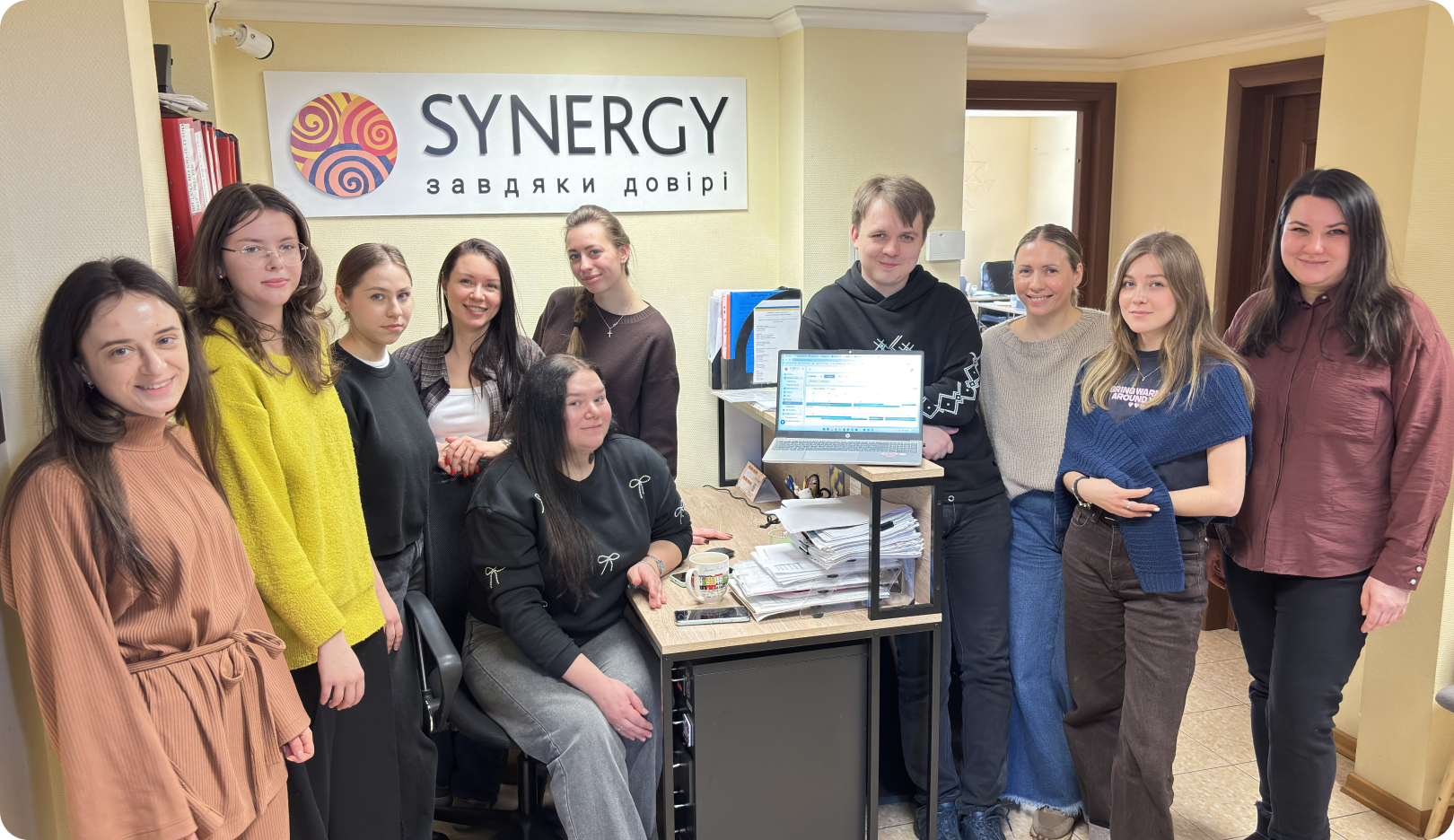
The Synergy Team
Starting point: when document management becomes a risk zone
Before moving to Uspacy, the company was already using another CRM system. Processes were in place, the team was familiar with the tool, and core tasks were being handled.
However, over time it became clear: the issue wasn’t the interface or the feature set. The key risk area was document management.
In a legal company, a document is not just a file. It’s a contract that defines the scope of collaboration. It’s an invoice tied to a specific legal action. It’s a certificate of completion that confirms results. It’s a report that reflects the progress of a case.
And each of these must be interconnected and synchronized with the others.
A single deal may involve multiple items—for example, several trademarks or different legal actions within the scope of one client. All of this data must be reflected consistently across the contract, invoice, and certificate of completion. Any inconsistency is not just a risk—it’s a serious issue for the client.
Manually creating documents introduces constant operational strain. Are the correct details entered everywhere? Has an outdated template been used? Is the legal action specified correctly? Is the same item named consistently across the contract and the completion certificate?
In reality, no one can review dozens of documents every day with the same level of focus. And in the legal business, even a small error comes at a high cost.
What was needed was a system that reduces reliance on human attentiveness and minimizes the risk of manual errors. That’s why Synergy defined a clear objective: standardizing client document workflows.
Finding the right solution: why a standard CRM wasn’t enough
The team explored a variety of solutions. Many systems were well-developed, offering advanced sales funnels, marketing tools, and analytics. However, most were built exclusively around sales and did not cover related processes.
Synergy’s business relies heavily on referrals, professional reputation, and partner relationships. Its core value isn’t the number of leads, but the quality of obligation fulfillment and legal accuracy.
The company needed a system that could support a custom workflow model: creating legal actions as distinct entities, adding dozens of specialized fields for different funnels, and managing multiple items within a single deal. The product catalog structure had to reflect real legal logic—not the other way around, where the legal practice is forced to conform to the CRM.
The turning point came with the launch of Uspacy’s hierarchical product catalog. For a company where service names may appear similar but differ in legal actions, cost types, and execution structure, this was critical.
The team had long awaited this tool, and its implementation ultimately made a full transition to the new system possible.

The Synergy Team
Building a system tailored to specific needs
After moving to Uspacy, Synergy didn’t just configure a CRM—they built their own operational model: structured, formalized, and logically complete.
Smart objects instead of template fields
The standard company fields didn’t match the specifics of their practice. The team therefore discarded them entirely and created custom “smart objects”—bilingual, with considerations for different client types and data structures.
Four types of smart objects were created, forming the foundation for document generation. The system, in effect, began operating according to these rules rather than standard CRM logic.
Complex deal structure
Each deal contains approximately one hundred custom fields—and this is not an exaggeration, but a reflection of the practice’s real complexity.
A single deal can include:
- multiple intellectual property assets;
- a list of legal actions;
- different contracting parties;
- specific financial parameters;
- additional contractual conditions.
This level of detail allows the legal logic to be captured even before a document is created.
Typical process today
Leads come in through the website, email, partner channels, or are created manually. The assistant sets up the campaign and deal, populates smart objects with client details, and adds legal actions, assets, and products.
The system then generates documents—contracts, addenda, invoices, certificates, and reports—based on approved, legally verified templates.
Document generation is automatic, but the logic is strictly structured. Client information is entered once and never rewritten manually. If a specific trademark is added to a deal, it automatically appears in all related documents. Any parameter change is reflected across the system, not just in a single document.
This means the system does more than assist—it enforces discipline in the process and eliminates mechanical inconsistencies.
Integrations and ongoing development
Beyond document management, the company has integrated telephony with call recording, a website form for automatic lead creation, and has tested integration with an electronic signature service.
"Working with smart objects is very easy and convenient. This tool allows us to build a custom business process that works specifically for our needs."

Lesya Sholudko
Finansial Strategy & Planning Advisor
The system is not static—it evolves alongside the practice. Planned developments include tracking trademark deadlines via smart objects, billing lawyers’ working hours, integrating messaging apps, and deeper use of tasks and business processes.

The Synergy Team
Outcome: reduced risk, increased control
The first improvement the team highlights is enhanced service quality. Standardized templates reduce the risk of errors—a critical factor in the legal business.
Second is speed. Tasks that were previously done manually can now be completed in minutes. There’s no need to repeatedly check client details, recall exact wording, or search for a previous version of a document.
Third is structure. All client information is stored in one place. If a case transitions from one lawyer to another, it remains intact, without breaking into fragments or losing context.
Another significant benefit: assistants manage document workflows, freeing lawyers to focus on more complex, revenue-generating work.
Lawyers stop acting as document operators and return to their primary role—analysis, strategy, and legal positioning.
Key value
"For the company’s two practices, which primarily work with clients on an hourly billing basis, this CRM solution has proven far more than simple document automation. The system also handles hourly billing, project and task management involving multiple lawyers, and deadline control. Altogether, it significantly simplifies team coordination and makes processes more predictable and manageable."

Anna Kravchuk
Partner, Head of IP/IT Contracts and Tax Practice
"For the intellectual property registration practice, systematic control over leads and their processing is critical. Thanks to the CRM, we can track the full client interaction cycle: logging calls, routing them to the responsible lawyer, monitoring request handling, and ensuring service quality. Equally important, the system organizes the complex document workflow with clients, keeping all client work structured."

Viktoriia Ostapchuk
Managing Partner, Head of Intellectual Property Registration Practice
The system has enabled the formalization of complex legal processes, established standards, minimized human error, and maintained service quality even as case volumes grow.
Where tension and uncertainty once prevailed, the system now ensures control and predictability.
For a legal firm, this means more than simple automation—it represents a shift from manual discipline to a structured, systematic approach.