AI doesn't read minds: why artificial intelligence performs better when your CRM is already organized
June 15, 2026
7-minute read

Dmytro Suslov

AI does not create order in sales on its own. It delivers real value when the CRM already contains up-to-date data, recorded communications, clear deal stages, and specific next steps. That is why AI should be seen not as a magical solution, but as a tool that enhances an already well-structured system.
Businesses often expect AI to be almost magical — to automatically organize customer data, identify weak points in sales, suggest next steps, and bring order to managers’ workflows. But artificial intelligence does not operate on assumptions. It relies on the data that already exists in the system.
The core idea is actually simple: AI enhances the system rather than replacing it. If there are duplicates in the CRM, empty fields, deals without responsible owners, and agreements remain in chats and in the manager’s memory, artificial intelligence will not fix this automatically. It will only show more quickly where the process is already getting stuck.
That is why order in the CRM is the foundation for real value from AI. Next, we’ll look at why this happens and how Uspacy helps combine CRM, Communication hub, tasks, automation, analytics, and AI capabilities in one space.
AI does not create order out of chaos — it works with what already exists in the system.
Artificial intelligence analyzes not a manager’s intentions, but concrete work results. For it, messages, emails, comments, notes, calls, tasks, interaction history, and changes in the sales funnel are important. If this data is missing or scattered across different services, the result will be just as fragmented.
This is clearly illustrated by a simple example. A manager held a call but did not update the deal stage, did not enter the result into the customer card, and did not create a follow-up action. In such a situation, AI will not know that the client is waiting for a commercial proposal by the end of the day. It cannot guess what is not in the system.
In Uspacy, AI capabilities work directly with already recorded context: they can transcribe calls, generate short summaries of conversations, create tasks from emails, messages, comments, and notes, and also summarize long discussions. In other words, there must first be something to analyze before anything can be accelerated.
For artificial intelligence to truly support business, a clear environment must first be created for it — a CRM with up-to-date data, tasks, and a complete communication history.
Why high-quality CRM data matters more than the mere presence of AI
In the case of Uspacy, the value of AI does not appear at the moment a feature is activated, but when there is already a solid working context in the CRM. If a customer record contains contacts, interaction history, deal stage, and next actions, the system truly helps move sales forward faster and avoid losing agreements.
This is important because AI capabilities in Uspacy do not operate “outside the process,” but within it. They help summarize calls, generate follow-up emails, create tasks from emails, messages, comments, and notes, and make it faster to move from communication to concrete action. When the context is complete, the team genuinely saves time.
When, however, there are duplicates in the database, deals are managed inconsistently, part of the communication remains in personal messengers, and data is not linked to a lead, contact, or deal, AI simply cannot see the full picture. In such a situation, the problem is not the tool, but the quality of the data. Incomplete context leads to incomplete output and weaker insights.
In Uspacy, it is logical to start not with the idea of “turning on AI,” but with bringing order to the CRM, sales funnel, customer cards, and tasks. Only on this foundation do AI capabilities deliver real practical value: reducing manual routine work, speeding up information processing, and helping preserve context in daily operations.
What a CRM must have for AI to truly support sales
To make AI useful in sales, the CRM must reflect the real process, not its formal version. The system should not contain “checkbox data,” but living information that the team actively uses every day.
The basic AI readiness of a CRM in Uspacy looks like this:
- A current customer database. Contacts and companies should contain key information so that a manager can see the customer and the entire interaction history in one place.
- A clear sales funnel. Stages should reflect the real customer journey, not serve as abstract labels for reporting. Uspacy places strong emphasis on funnels built around a company’s actual internal processes.
- Recorded tasks and agreements. After an email, call, or discussion, a follow-up action should always be created. In Uspacy, AI can generate tasks from messages, comments, and notes, but the team then works with them as a full part of the process.
- Communication history. Calls, emails, messages, and chats must be linked to leads, deals, contacts, or companies so that context is never lost. This is exactly why Uspacy includes a Communication hub with a unified channel view and CRM linkage.
- Analytics. Managers need to see not only results, but also bottlenecks: leads, sources, revenue, average check, deal duration, as well as employee tasks and activities. This helps identify where the process slows down and what needs improvement.
When these elements are brought together in one workspace, AI stops being a separate “nice feature.” It becomes a practical assistant that processes information faster, preserves context, and helps the team move from communication to action.
Comparison example: AI in chaos vs. AI in a structured process
The difference is best seen in two scenarios. In the first, a manager keeps part of the agreements in a messenger, does not log the call outcome in the CRM card, and leaves next steps “for later.” In such a process, AI has almost nothing to work with: it cannot properly summarize the conversation, generate an accurate follow-up email, or turn an agreement into a task if the context itself is not collected in the system.
In the second scenario, the call is saved in the CRM card, correspondence is linked to the customer, and important messages and comments remain within the workspace. Then the AI capabilities in Uspacy provide tangible value: the system can transcribe the call and produce a short summary of the conversation, generate a follow-up email for the client, create a task from an email, message, comment, or note, and quickly compile a summary of a long discussion in a task or in the Newsfeed.
The conclusion is simple: artificial intelligence in Uspacy does not replace discipline in customer work — it enhances it. When communications, agreements, and next steps are recorded in the system, AI helps the team move faster from conversation to concrete results.
How Uspacy helps prepare a CRM for effective AI use
The strength of Uspacy lies in the fact that artificial intelligence does not exist separately from the team’s daily work. The platform unifies CRM, tasks, communications, automation, and analytics into a single digital workspace. This reduces the need to switch between tools and helps keep the entire context in one place.
In practice, it works like this. The CRM collects customers, leads, deals, and interaction history. Tasks allow agreements to be immediately turned into concrete actions. The Communication hub helps preserve context across emails, calls, chats, and the sales process. Automation reduces the number of manual steps, while analytics shows managers where delays occur and what requires attention.
On this foundation, AI capabilities in Uspacy function as an acceleration tool rather than a separate “smart add-on.” They help teams quickly capture the essence of a call after it ends, avoid spending time on manual follow-ups, immediately turn emails or internal discussions into actionable tasks, and quickly extract key points from long conversations. In other words, AI does not replace the process — it removes routine workload where the context is already structured in the system.
That is why sequence is critical: first comes a structured process, then enhancement through AI. In this model, artificial intelligence does not compensate for chaos — it increases the speed, accuracy, and manageability of an already well-organized workflow.
Conclusion
AI is not a magic button that automatically fixes business chaos. It does not read managers’ thoughts, it does not know about agreements that are not recorded in the system, and it cannot properly analyze processes when data is scattered across spreadsheets, chats, and personal notes.
The real value of artificial intelligence is unlocked when the CRM is already structured: up-to-date customer data, a clear sales funnel, recorded tasks, a full communication history, and basic analytics. In that case, AI does not try to guess what is happening — it helps process real context faster.
For business, this means one thing: the greatest benefit from artificial intelligence is gained by teams that already work in a shared digital environment. When customers, deals, communications, and tasks are brought together in Uspacy, AI not only saves time but also helps maintain workflow pace, respond faster to changes, and reduce workload.
Updated: June 15, 2026
More materials on the topic

When artificial intelligence becomes a team member: how managers can manage the work of people and AI assistants
August 20, 2026

Modern CRM in 2026: 7 essential requirements for businesses
August 14, 2026

A voice assistant in CRM isn’t just a novelty: what sales challenges it helps solve
August 12, 2026
FAQ
Why doesn’t AI deliver the expected results when the CRM is messy?
What CRM data is most important for effective AI performance?
Are AI capabilities in Uspacy available immediately?
Which Uspacy AI features are most useful in daily work?
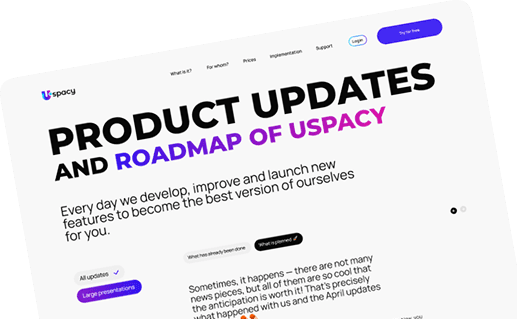
Uspacy is improving and developing at an incredible speed
Learn about product development plans
Uspacy roadmap 🚀