ChatGPT and AI in Uspacy: How to use artificial intelligence in CRM work
June 26, 2026
7-minute read

Dmytro Suslov

ChatGPT has already become a valuable assistant for sales representatives and managers when it comes to content creation, idea generation, and communication preparation. At the same time, the built-in artificial intelligence in Uspacy handles routine CRM-related tasks by helping teams capture agreements, summarize calls, and keep track of next steps. Together, these capabilities provide businesses with both flexibility and operational consistency.
Sales and customer service teams no longer want to spend time on repetitive administrative work. No one wants to listen to the same call twice, manually extract key agreements from email threads, or write every follow-up from scratch. Businesses are adopting AI not because it is a trend, but because it delivers greater speed, accuracy, and control over day-to-day operations.
This is where artificial intelligence begins to deliver real business value. AI is most effective not when it exists separately from business processes, but when it operates directly within sales workflows, communications, and team tasks. Otherwise, it remains an interesting experiment that does little to improve productivity.
That is why it is important to understand where ChatGPT serves best as a universal assistant and where Uspacy’s built-in AI capabilities provide greater value through their direct integration with CRM processes.
ChatGPT in CRM: what it can and cannot do
ChatGPT is particularly useful when sales representatives need to quickly prepare communications, organize their thoughts, or find the right wording. It accelerates many routine sales-related tasks, but it does not replace a CRM system itself—especially when dealing with processes that are already automated through Uspacy AI.
How ChatGPT can support CRM work:
- Prepare responses to customer objections.
- Create draft sales scripts.
- Write messages for reactivating inactive contacts.
- Generate email templates for different customer segments.
- Analyze common reasons why deals are lost.
- Assist with preparation for the next customer interaction.
- Suggest communication approaches for different stages of the sales funnel.
For example, a sales manager can provide ChatGPT with a brief description of a situation and receive several response options for objections related to pricing, timelines, or partnership terms. They can also request an email template for a follow-up, ideas for a reactivation campaign, or a conversation structure for an important meeting. This helps save time and enables teams to move from planning to action more quickly.
That is why ChatGPT should be used to prepare and strengthen communication, while the CRM serves as the system of record for facts, structure, and team collaboration. One tool helps shape the message. The other provides control over the deal, next steps, and the complete history of customer interactions. Together, they create a powerful combination. Separately, each delivers only part of the value.
AI capabilities already available in Uspacy
The integration of artificial intelligence into the workspace automates not generic processes, but clearly defined day-to-day tasks. Sales representatives no longer need to revisit calls to recall important details, reread lengthy comment threads, or manually transfer agreements into tasks. This is where Uspacy functions not as a standalone CRM, but as a comprehensive business platform that connects sales, communications, and teamwork in a single environment.
Call management is one of the most valuable use cases. Uspacy AI automatically transcribes conversations, generates concise summaries, and saves them directly to the CRM record. As a result, sales representatives can immediately see the key takeaways from each interaction: what interested the customer, which terms were discussed, what agreements were reached, and what the next step should be. In addition, the system generates a follow-up email after each call, allowing communication to continue without unnecessary manual effort or the risk of losing important details.
An equally important capability is turning communication into action. In Uspacy, tasks can be created directly from emails, messages, comments, and notes—right at the point where a request or agreement originates. This reflects how work actually happens: a customer sends additional information by email, a colleague leaves a comment on a deal, or a manager records an idea in a note. Any of these interactions can be instantly converted into a task with a responsible owner, deadline, and clear description. As a result, teams stay aligned, follow-up actions are not overlooked, and important commitments do not remain dependent on someone's memory.
Another valuable AI-powered scenario is summarizing lengthy discussions in tasks and the Newsfeed. When a conversation contains numerous comments, AI helps quickly identify the key points: what has already been decided, which issues remain unresolved, and who is responsible for each action item. This is particularly useful for managers and team leaders who join a discussion after it has already been underway. Instead of spending time reconstructing the context, they can immediately understand the situation and move the work forward. This is how artificial intelligence in Uspacy goes beyond simple text generation—it helps teams maintain momentum in sales, communications, and day-to-day collaboration.
AI use cases in sales
AI delivers the greatest value at the moment when a team needs to move from a customer interaction to concrete action. Sales processes rarely stall because of a lack of information. More often, the real challenge is that important agreements are forgotten, next steps are not documented, and sales representatives return to conversations or email threads too late.
For example, after a call, Uspacy AI automatically creates a transcript and a concise summary within the CRM record. The sales representative can immediately see that the customer is interested in an integration, expects a commercial proposal by the end of the day, and is waiting for clarification regarding the implementation timeline. The key points of the conversation are already captured in the system, allowing the representative to move forward immediately instead of relying on memory to reconstruct the discussion.
Another common scenario involves emails and customer messages. A customer sends a request containing several questions about pricing, partnership terms, and a product demonstration. Instead of leaving that email in an inbox, the sales representative can instantly convert it into a task in Uspacy. As a result, the team receives a clearly defined action item, an assigned owner, and a deadline, ensuring that the request does not get lost among other communications.
In scenarios like these, AI functions not as a text-generation tool, but as a solution that helps maintain deal momentum. Once routine operational tasks are already handled within Uspacy, ChatGPT can be used for additional support, such as preparing sales arguments, drafting response templates, or generating new communication ideas.
Where ChatGPT can complement Uspacy
ChatGPT delivers the most value when sales representatives need to quickly prepare for customer interactions or evaluate a situation from a broader perspective. It can help create sales scripts for different customer profiles, develop responses to common objections, identify new ways to re-engage customers, and formulate next steps after complex negotiations. This saves time and often provides fresh communication approaches that may not have been considered otherwise.
For example, a sales representative may notice that a customer repeatedly raises concerns about pricing. In this situation, the representative can provide ChatGPT with a brief overview of the case—without sharing confidential information—and ask for three response options: one for a phone call, one for an email, and one for a message. Another common use case is customer reactivation. When a representative wants to reconnect with customers who have not engaged for a long time, ChatGPT can generate communication ideas and suggest messaging approaches tailored to different customer segments.
Another valuable application is analyzing lost opportunities. By summarizing several cases without including personal or sensitive information, ChatGPT can help identify recurring patterns, such as weak qualification, delayed follow-up, unclear value communication, or challenges during the approval stage. It is also useful for creating email templates, drafting message variations, and preparing conversation frameworks ahead of important meetings.
However, one principle remains unchanged: factual data, interaction history, deal statuses, and team tasks should remain within the CRM system. ChatGPT enhances communication, messaging, and preparation. Uspacy serves as the central workspace that captures processes, preserves context, and enables effective collaboration across the entire team.
Data security: what should not be shared with ChatGPT
AI improves productivity only when it does not introduce new risks. That is why, when working with external tools, organizations should clearly distinguish between useful automation and unnecessary data sharing. For businesses, this is not a minor technical consideration—it is a matter of trust, reputation, and internal governance.
Customer personal data, contracts, financial terms, confidential correspondence, and internal company information should not be shared with ChatGPT without clearly defined security policies and controls. Even when using AI to analyze a case or prepare a response, it is best to anonymize the request by referring to “Customer A,” “Company B,” “a deal of a certain value,” or “a common budget-related objection.” This preserves the context of the situation while minimizing unnecessary risk.
The right approach is straightforward: use AI where it helps accelerate work, but avoid exposing sensitive information outside a controlled environment. The operational source of truth about customers should remain within the CRM system, while external AI tools should serve as a complementary layer that supports productivity and communication.
Conclusion
ChatGPT is valuable for generating ideas, drafting content, analyzing situations, and preparing communications. However, businesses gain the greatest value when AI is embedded directly into daily workflows—including calls, emails, CRM records, tasks, and team collaboration. This is where artificial intelligence moves beyond the “wow factor” and becomes a practical tool for saving time and improving productivity.
Uspacy already provides these capabilities within a unified workspace. It is more than a standalone feature—it is a connected set of tools where CRM, communications, task management, and automation work together seamlessly. For small and medium-sized businesses, this means fewer disconnected systems, less manual work, and greater control over the sales process.
When AI becomes part of the workflow, teams can work faster, more efficiently, and with greater confidence. The next logical step is not simply to experiment with ChatGPT on its own, but to explore Uspacy’s AI capabilities within real-world CRM processes and everyday team operations.
Updated: June 26, 2026
More materials on the topic

When artificial intelligence becomes a team member: how managers can manage the work of people and AI assistants
August 20, 2026

Modern CRM in 2026: 7 essential requirements for businesses
August 14, 2026

A voice assistant in CRM isn’t just a novelty: what sales challenges it helps solve
August 12, 2026
FAQ
How does ChatGPT differ from the built-in AI in Uspacy?
Which AI scenarios in Uspacy provide the most value for teams?
What is the best way to combine ChatGPT and Uspacy in daily work?
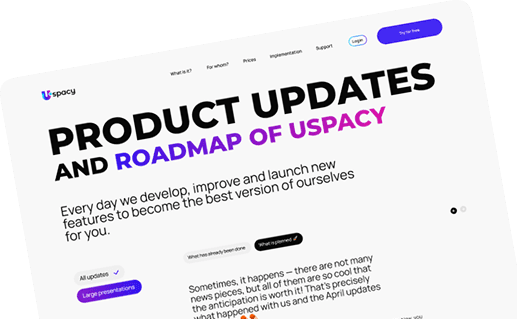
Uspacy is improving and developing at an incredible speed
Learn about product development plans
Uspacy roadmap 🚀