Performance Review: How to use task history for objective employee evaluation
May 18, 2026
7-minute read

Dmytro Suslov
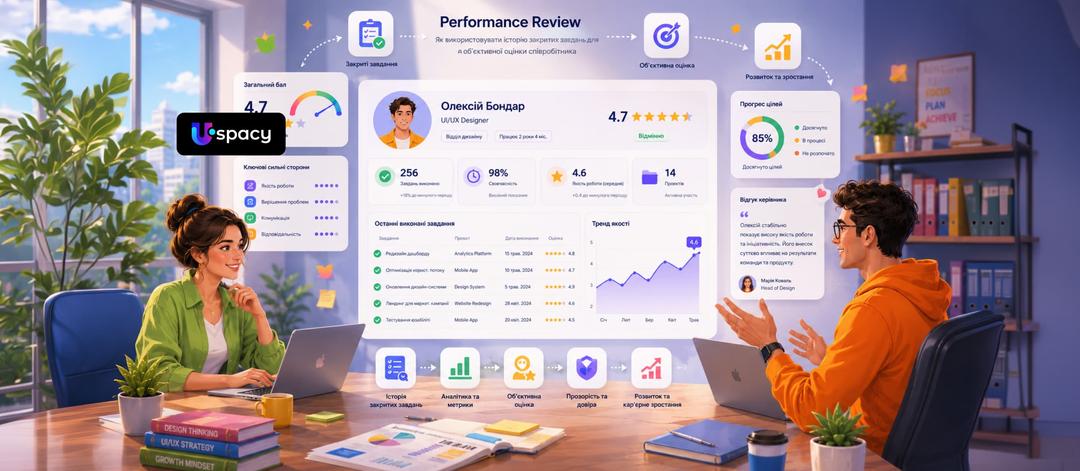
Facts instead of impressions — this is how a fair Performance Review should work. Completed task history, deadline adherence, and execution quality help reveal an employee’s real contribution without emotions or assumptions. When evaluation is based on data, feedback becomes constructive and development decisions become more fair.
Performance Review — a periodic performance evaluation — is often perceived as a formality or as a conversation that will inevitably leave someone dissatisfied. The reason is simple: managers often rely on impressions rather than facts. As a result, employee evaluation shifts toward emotions, while everyday routine work that keeps processes running is often overlooked.
The solution lies in using task history within a unified task tracker. It provides clear visibility into what was completed, on what timeline, with what level of quality, and at which stages delays occurred. This approach shifts performance management away from subjective impressions and toward fact-based evaluation, where completed tasks become the foundation for honest and constructive conversations.
Constructive feedback: how task analysis helps build development plans
During 1-on-1 meetings — private conversations between managers and employees — and quarterly reviews, the recency effect often comes into play. This cognitive bias causes people to focus on recent events instead of the full picture accumulated over six months or a year. A single recent mistake can easily outweigh dozens of strong results.
That’s why objective evaluation should rely not on memory, but on a digital record of work. In Uspacy, managers and employees can open the history of completed tasks, filter a specific time period, and review the same set of data together. This removes emotions and personal bias from the discussion, making conversations calmer, more productive, and fact-based.
This also changes the quality of feedback. Instead of vague statements like “things have been slow lately,” discussions become specific: how many tasks were completed, how many were delivered on time, and where recurring revisions or delays occurred. This format avoids personal criticism. Instead, it highlights what is working well and what needs improvement.
For HR teams and line managers, this is also a way to reduce tension during reviews. Employees can clearly see that their performance is not being judged subjectively — their contribution is visible in the system. As a result, Performance Review stops feeling like a stressful exam and becomes a genuine development tool.
Which task tracker metrics to use for Performance Reviews
For data-driven HR — an HR approach based on data — to truly work, it’s not enough to simply look at the number of completed tasks. Multiple performance indicators need to be evaluated simultaneously. Together, they provide a balanced picture without leaning too heavily on either emotions or numbers.
The first metric is the percentage of tasks completed on time. It reflects how well an employee manages workload planning, estimates capacity, and meets deadlines. If Uspacy reveals consistent delays, it becomes a reason to discuss not only discipline, but also prioritization, workload distribution, or the quality of task assignment itself.
The second metric is the number of tasks returned for revision. If tasks regularly move from “Ready for review” back to “In progress,” it may indicate issues with quality, attention to detail, or unclear completion criteria. In Uspacy, this status history is fully preserved, allowing reviews to rely not on general impressions, but on recurring patterns.
The third metric is proactiveness. This can be seen in who creates tasks, how employees document process improvements, and whether they take ownership of cross-functional coordination. When an employee goes beyond simply executing assignments and actively defines next steps, it becomes a strong argument during a review — especially in a system where all of this activity is documented.
These metrics should also be analyzed alongside KPIs. While KPIs measure business outcomes, task history explains how the team achieved them. Together, they provide a complete and objective view of performance without unnecessary subjectivity.
Process transparency: how task tracker data supports fair workplace evaluations
A system should not exist to find someone to blame. Its primary purpose is to identify bottlenecks within a process. If a specialist completes half of their tasks behind schedule, the issue may not be the employee at all — it could stem from unclear requirements, workload overload, or slow approvals from other team members.
In Uspacy, this becomes much more visible because task history goes far beyond a simple “completed” or “not completed” status. The system shows who assigned the task, when statuses changed, where comments appeared, at which stage delays occurred, and how much time the task spent in each status. This transforms evaluation from subjective impressions into a clear and measurable workflow history.
This is exactly the kind of foundation needed to build a fair PDP — a Personal Development Plan. If the data shows recurring difficulties with certain types of tasks, the right solution may involve additional training, mentorship, or adjustments in role distribution. If the system reveals that delays originate during task assignment or approval stages, then the process itself — not the employee — should be improved. That is the value of Uspacy as a comprehensive workspace platform: it allows teams not only to maintain task history, but also to build a more transparent operational model without constantly switching between different tools and services.
Employee transparency: turning task data into career growth opportunities
A fair Performance Review is important not only for managers, but also for employees. Team members should understand that every well-executed task contributes to their professional reputation. When work is documented in a system, achievements are not forgotten — they accumulate over time.
Before a review, employees can prepare on their own. In Uspacy, this is as simple as filtering their completed tasks, reviewing the most challenging cases, identifying process improvements they initiated, analyzing tasks completed without delays, and highlighting projects that delivered measurable business impact. This kind of self-assessment makes conversations more confident, structured, and meaningful.
This becomes especially valuable during salary or promotion discussions. Instead of saying, “I’ve done a lot,” employees can present clear, data-backed arguments: consistency, quality, speed, initiative, and contribution to business processes. The conversation shifts from a request based solely on trust to a position supported by evidence.
This level of transparency also benefits businesses. It reduces tension, strengthens trust, and creates clear and consistent expectations. When objective evaluation is based on system data rather than a manager’s mood or personal perception, companies are better positioned to retain and develop strong talent.
Conclusion
Performance Review is not a school exam or a trial of an employee. It is a practical tool that helps align business expectations with an individual’s work, identify strengths, uncover growth areas, and agree on next steps. Task history makes this process fairer by relying on facts rather than selective memory or emotions.
When team work is recorded in a unified task tracker, feedback becomes more specific, KPIs become clearer, and decisions about development, workload, or changes in employment conditions become better justified. This is not about control for the sake of control. It is about transparency, fairness, and a shared understanding of outcomes.
That is why these processes should be managed in a single environment where tasks, comments, statuses, and work context are not lost. Uspacy addresses this need in a comprehensive way by combining tasks, communication, automation, and work context in one product. The team gets a unified space for daily work, while managers gain a reliable foundation for reviews where facts outweigh assumptions.
Updated: May 18, 2026
FAQ
What is a Performance Review in simple terms?
How does task history make performance reviews more objective?
How can an employee prepare for a Performance Review using task history?
Is task tracker data enough for employee evaluation?
Why is a unified workspace useful for this process?
Uspacy is improving and developing at an incredible speed
Learn about product development plans
Uspacy roadmap 🚀